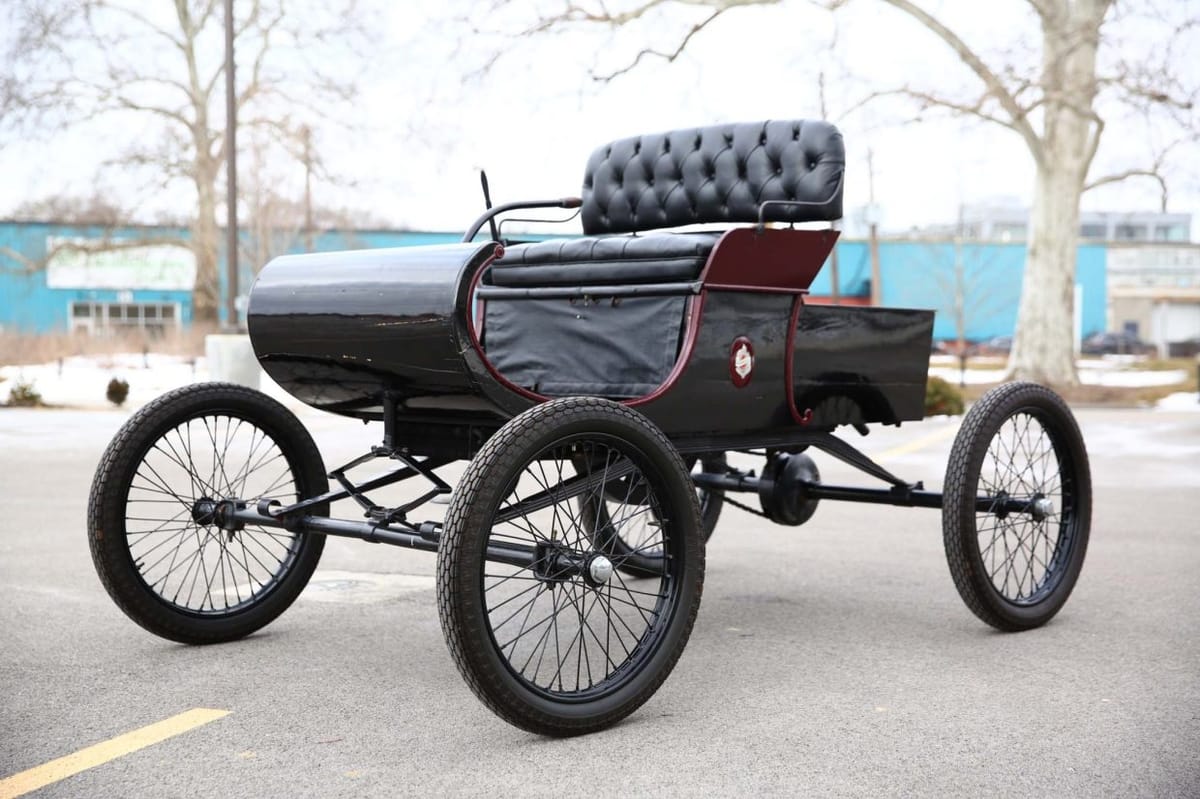
1902 – Oldsmobile Curved Dash
In 1902 the world was still learning how to move faster than a horse without feeling guilty about it, and into that cautious, curious age rolled the Oldsmobile Curved Dash, a little machine that didn’t roar with arrogance but whispered a promise of freedom. It didn’t look like the future people imagined in science fiction, it looked like a neat wooden carriage that had decided to think for itself, and that was exactly why it worked.
The Curved Dash was friendly, unintimidating, almost polite, with its signature curved dash panel designed to protect the driver from mud and stones, a practical touch that said this car understood real roads and real people. Built by Ransom E. Olds, this was not a toy for the wealthy tinkerer or a temperamental contraption for engineers to admire from a distance, it was a car meant to be used, driven, trusted, and that intention changed everything. At a time when automobiles were often handcrafted one by one like fragile art pieces, Oldsmobile quietly introduced a revolutionary idea: standardization. Parts were made to fit other parts, assembly became repeatable, repairs became possible without panic, and suddenly the automobile began to feel less like an experiment and more like a companion.
The Curved Dash was light, simple, and surprisingly reliable, powered by a modest single-cylinder engine that didn’t try to impress anyone but showed up every morning ready to work. It wasn’t fast by modern standards, but in 1902 it felt liberating, like owning your own sense of direction. Farmers used it to reach town, doctors used it to reach patients, and ordinary people began to imagine lives that were no longer bound by train timetables or exhausted horses. This car didn’t demand courage, it rewarded curiosity, and that made all the difference. There is something deeply human about the Curved Dash because it arrived before ego entered the automobile conversation. There were no luxury badges, no status games, no talk of dominance on the road. It was about getting from here to there with dignity and a little joy. Even the way it sounded, a gentle chug rather than a commanding growl, felt like reassurance rather than intimidation.
The car was affordable for its time, mass-produced in numbers never seen before, and in doing so it quietly taught society that technology didn’t have to be exclusive to be transformative. When people bought a Curved Dash, they weren’t just buying transportation, they were buying time, independence, and a subtle belief that progress could be practical instead of overwhelming. You can imagine an early morning in 1902, mist still hanging low, someone adjusting their hat, giving the engine a careful crank, feeling that small moment of hesitation before motion, and then smiling as the car responds faithfully. That smile is the real legacy of the Oldsmobile Curved Dash. It represents the moment the automobile stopped being a spectacle and started becoming a habit. Long before highways, traffic rules, or fuel stations on every corner, this little car helped society rehearse a new way of living. It taught people to trust machines, to plan farther, to think bigger without shouting about it.
In the long story of automotive history, the Curved Dash may seem humble, even quaint, but humility is often where revolutions begin. This was not the car that tried to conquer the world, it was the car that gently invited the world to move forward, one dependable mile at a time.