
1904 The Gentleman of the Road
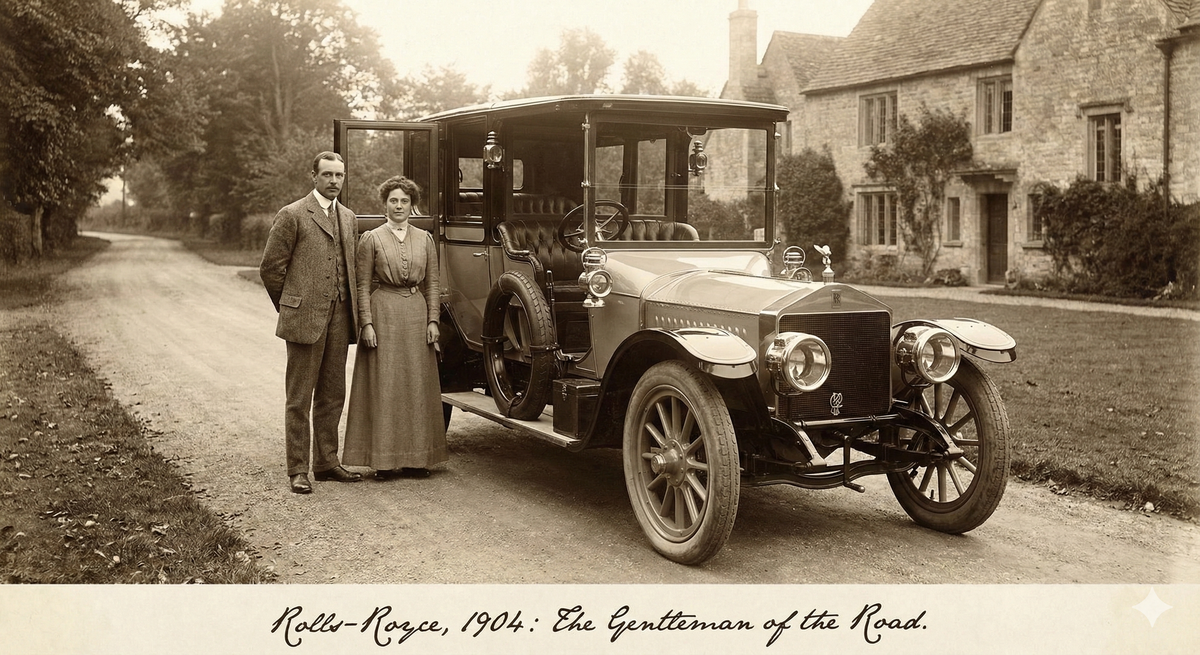
1904 was the year the automobile learned how to behave like a gentleman, and that transformation came quietly through the first true expression of . Before this moment, cars were noisy, temperamental creatures that demanded constant attention, like brilliant but unruly children. What emerged in 1904, through the partnership of and , was something very different in spirit. This was not a machine trying to prove it was powerful, it was a machine trying to prove it was trustworthy. The early Rolls-Royce cars did not shout their presence; they moved with composure, as if aware that true confidence does not require noise. Starting one felt less like wrestling with a device and more like being greeted by a well-trained companion that knew its role. The engine ran smoothly for its time, almost apologetically, reducing vibration and unpredictability in a world that had already accepted mechanical chaos as normal. This calmness was revolutionary. In an era when drivers expected breakdowns as part of the journey, Rolls-Royce introduced the radical idea that a car should simply do what it was asked, consistently and without drama. Owners began to feel something new behind the wheel: relief. Relief that the car would start, relief that it would not embarrass them on the road, relief that progress could feel dignified rather than exhausting. There was also an emotional shift taking place. These cars encouraged a slower, more assured relationship with movement. You didn’t drive to conquer distance; you drove to arrive well. Passengers trusted the car enough to converse, to observe scenery, to exist in the journey rather than survive it. That psychological change mattered as much as any mechanical innovation. The 1904 Rolls-Royce spirit treated engineering as an act of respect toward the user, not a display of ego. Every mile reinforced the idea that excellence was not about excess but about refinement, about removing stress rather than adding spectacle. Even those who never owned one felt its influence, because it raised expectations for the entire industry. From that year onward, smoothness became a goal, reliability became a standard, and silence became a virtue. In human terms, 1904 marks the moment the automobile stopped behaving like an experiment and started behaving like a promise. It suggested that machines could be courteous, that technology could serve without shouting, and that progress, at its best, feels less like acceleration and more like peace.