Āṇḍāḷ — The Divine Girl Who Sang Herself Into God’s Heart
🌺
Āṇḍāḷ is not just an Āzhvār; she is a phenomenon of pure, fearless, divine love. She stands alone in the spiritual history of the world as a young girl who refused to see God as distant, who refused to hide her devotion behind ritual or formality, and who dared to love the Supreme with complete innocence and total surrender. Her life and poetry continue to inspire millions across centuries, cultures, and languages because they touch a part of the human heart that longs to love without hesitation and to be loved without condition.
Born in Srivilliputhur and discovered as a baby under a tulsi bush by Periyāzhvār, she grew up in an atmosphere saturated with devotion. Periyāzhvār did not raise her as a princess or a scholar but as a child whose breath itself carried the name of the Lord. She watched him sing lullabies to baby Krishna, offer garlands, and decorate the temple deity. In this environment of tenderness, Āṇḍāḷ’s devotion did not have to be taught; it blossomed naturally, like the fragrant jasmine that filled the gardens around her home.
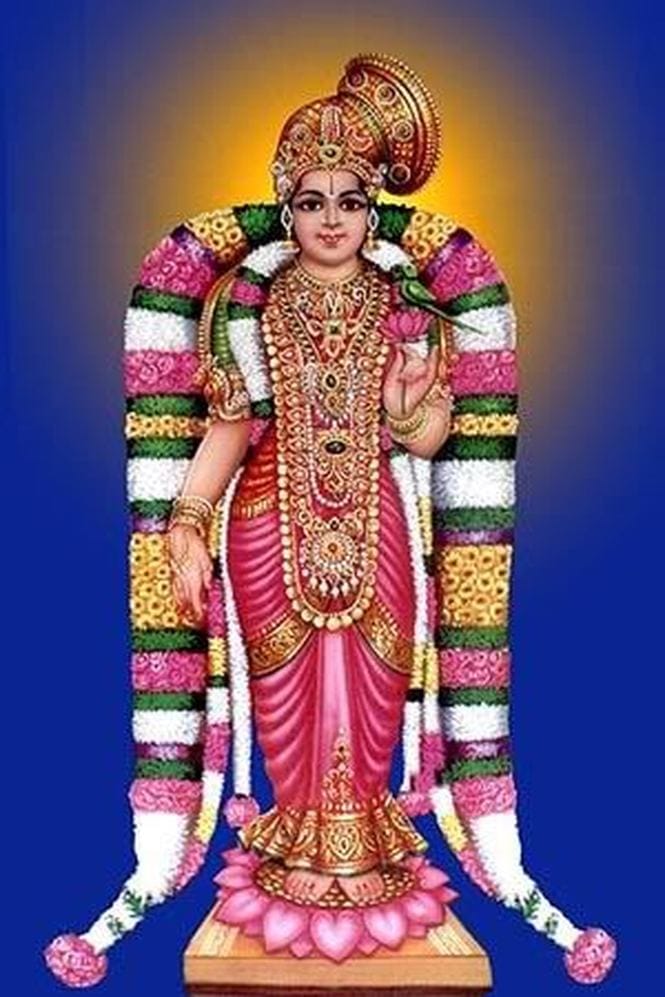
One of the most enchanting aspects of her life is the garland episode. Periyāzhvār would weave garlands for the Lord every day, and little Āṇḍāḷ, in her innocence, would secretly wear them first and admire herself in the mirror. She wanted to see whether she was suitable for the Lord she adored. When her father discovered this, he was horrified and stopped using those garlands. But the temple deity appeared in his dream and said, “I want only the garlands worn by Āṇḍāḷ.” From that day, she became known as Sūḍik Kodutta Sūdēzhi — the girl who offered garlands after wearing them, a symbol of devotion so pure that God accepted it joyfully.
Her literary masterpiece, the Tiruppāvai, is a set of thirty verses sung in the Tamil month of Mārgaḻi, celebrating the soul’s journey toward God through the metaphor of young girls performing a sacred vratham. Though written by a girl in her teens, the Tiruppāvai contains layers of philosophy, symbolism, and emotional depth that scholars continue to explore even today. It speaks of friendship, unity, discipline, inner purification, surrender, and the sweetness of calling out to the Divine as one would call a beloved friend at dawn.
In the opening verse of Tiruppāvai, Āṇḍāḷ declares, “Let us bathe in the holy waters and observe the vow for Kṛṣṇa, the giver of pure grace.” This is not the voice of someone following tradition mechanically; it is the voice of a leader calling her community toward spiritual renewal. Every verse thereafter invites the reader into a world where devotion is alive — a world where the Lord is central to friendships, dreams, conversations, and aspirations.
One of the most profound verses is “Nārayana ne namakkē paṟai taruvān,” where Āṇḍāḷ expresses complete confidence that the Lord Himself will grant what is truly needed. The “paṟai” she asks for is not a drum but divine grace — the inner strength to live a righteous, meaningful life. She teaches that devotion is not begging; it is a joyful relationship where the devotee trusts the Lord completely.
Āṇḍāḷ’s second major work, the Nācciyār Tirumoḻi, reveals the emotional intensity of her love for the Divine. Unlike the gentle tone of the Tiruppāvai, these verses express longing, impatience, dreams, hopes, and the ache of spiritual separation. She speaks of sending messengers to the Lord, dreaming of wedding rituals, and yearning for union with Him. Far from being symbolic alone, these verses show a young girl who felt the presence of God as vividly as one feels the presence of a loved one. Her devotion was not abstract but personal, passionate, and fearless.
In one of the most celebrated verses, she says, “I will not marry any mortal being; my heart belongs only to Kannan.” This was not childish fantasy; it was her soul’s truth. When proposals came for her hand, she refused them all with a confidence and clarity rare even among adults. For her, the Lord of Srirangam, Ranganatha, was the only one she could ever accept as her eternal companion.
The culmination of her story is both miraculous and symbolic. When she reached Srirangam, the temple priests adorned her like a bride and brought her before the Lord. In that sacred moment, Āṇḍāḷ merged into the divine presence — not metaphorically, but literally, according to tradition. Her disappearance within the sanctum is seen as the highest expression of divine union, showing that her devotion was so complete that no separation between devotee and Lord remained.
The spiritual significance of Āṇḍāḷ’s life lies in the power of her innocence. She did not approach God with fear, rules, or rigid rituals. She approached Him with the honesty of a child, the intensity of a lover, and the loyalty of a lifelong companion. Her verses do not preach; they invite. They draw the reader into a space of warmth where devotion is not a duty but a joy.
The Tiruppāvai, sung across the world every December–January, is considered the “essence of the Vedas” not because of its complexity but because of its purity. Āṇḍāḷ uses the voices of young girls to remind us that the first step in spiritual life is awakening together — as a group, a community, a sisterhood of souls seeking the same light. Her emphasis on rising early, bathing, sharing resources, singing together, and approaching the Lord with humility is not just ritual instruction but emotional guidance for living a meaningful life.
Another beautiful strength of her work is its inclusiveness. In the Tiruppāvai, she calls out to girls of different personalities — the sleepy one, the stubborn one, the shy one, the distracted one — and she invites them all to join the spiritual journey. There is no judgment, only encouragement. She teaches that everyone, regardless of temperament, has a place in the devotional path.
Āṇḍāḷ’s compassion extends beyond devotion to include nature itself. Her references to blooming flowers, chirping birds, fresh rivers, cool winds, and gentle dawns show her deep love for the world around her. In her verses, nature becomes a companion on the journey toward God, reminding us that spirituality is not separate from life but woven into its very fabric.
Today, Āṇḍāḷ remains the only woman among the twelve Āzhvārs, a symbol of feminine strength, intellectual brilliance, emotional depth, and spiritual authority. Temples dedicated to her stand across India and abroad, and millions chant her verses daily. She continues to empower young girls, inspire mothers, uplift seekers, and melt the hearts of the elderly with her timeless songs of devotion.
Her message across centuries is simple yet profound: Love God with your whole heart, without fear, hesitation, or pretence. Let devotion be natural, honest, and joyous. Even if the world does not understand your love, God will.
Āṇḍāḷ lived not as a saint who renounced life but as a girl who embraced love so fully that life itself could not contain her. Her poetry remains a companion for anyone yearning for meaning, connection, and divine warmth. Through her words, she whispers gently: “The path to God is not difficult; it is pure. Walk it with sincerity, and He will walk toward you with endless grace.”