BOZO 2: The Day the Ship Almost Left
There are days in shipping history when great vessels glide out of ports with silent dignity, flags steady, engines humming like poetry. At BOZO Shipping & Logistics, this was not one of those days. This was a day that began with promise, slipped into confusion, and then settled comfortably into its natural state: managed chaos with biscuits.
Mr. B.L. Ozo arrived early. This alone caused mild concern. The guard at the gate straightened up. The receptionist sat upright as though posture could rewrite history. Mr. Ozo walked in with unusual purpose, holding a file so tightly it looked like he was afraid it might escape and start a better company somewhere else.
“Today,” he announced, placing the file on the table with theatrical weight, “we dispatch Vessel 17. On time.”
The room absorbed this statement the way a cat absorbs a bath. No one objected. No one agreed. A few nodded with the gentle optimism of people who have seen many such mornings and survived all of them without actual dispatches.
Somewhere near the far wall, a clipboard was adjusted. A pen was clicked. A man coughed with ambition.
Captain Bartholomew Crank entered shortly after, wearing his cap at an angle that suggested either authority or a disagreement with gravity. He saluted Mr. Ozo with a delay that felt personal.
“Captain,” said Mr. Ozo, “today we move.”
“We always move,” said the captain, looking out of the window at a stationary crane. “The question is, in which direction.”
It was not the reassurance anyone needed, but it had the rhythm of confidence, and at BOZO, rhythm often replaced meaning.
On the ground, the staff had begun their daily exercise in professional avoidance. A crate had arrived. It was a perfectly ordinary crate. Wooden. Rectangular. Containing goods that had no emotional agenda. Yet it was surrounded by four men who looked at it as if it might speak first.
“Should we open it?” one asked.
“Let us not rush,” said another, already halfway into a thoughtful stance.
A third man inspected the rope securing the crate, nodding at it with deep respect. “Good rope,” he murmured, as though complimenting craftsmanship might reduce workload.
The fourth man took notes. Nobody knew what he was writing, including him, but the act of writing had proven, over the years, to be a powerful shield against participation.
Above them all, in the office, Mr. Ozo was explaining timelines with increasing detail and decreasing hope. He had drawn arrows on a whiteboard. The arrows had ambition. The arrows had direction. The arrows had no connection to the actual events unfolding below.
“Loading by 11,” he said.
“Which 11?” asked the captain, not as a challenge, but as a genuine curiosity.
Mr. Ozo paused. This was the kind of question that could destabilise a morning.
“Today’s 11,” he clarified, choosing firmness.
The captain nodded slowly, as if accepting a philosophical position.
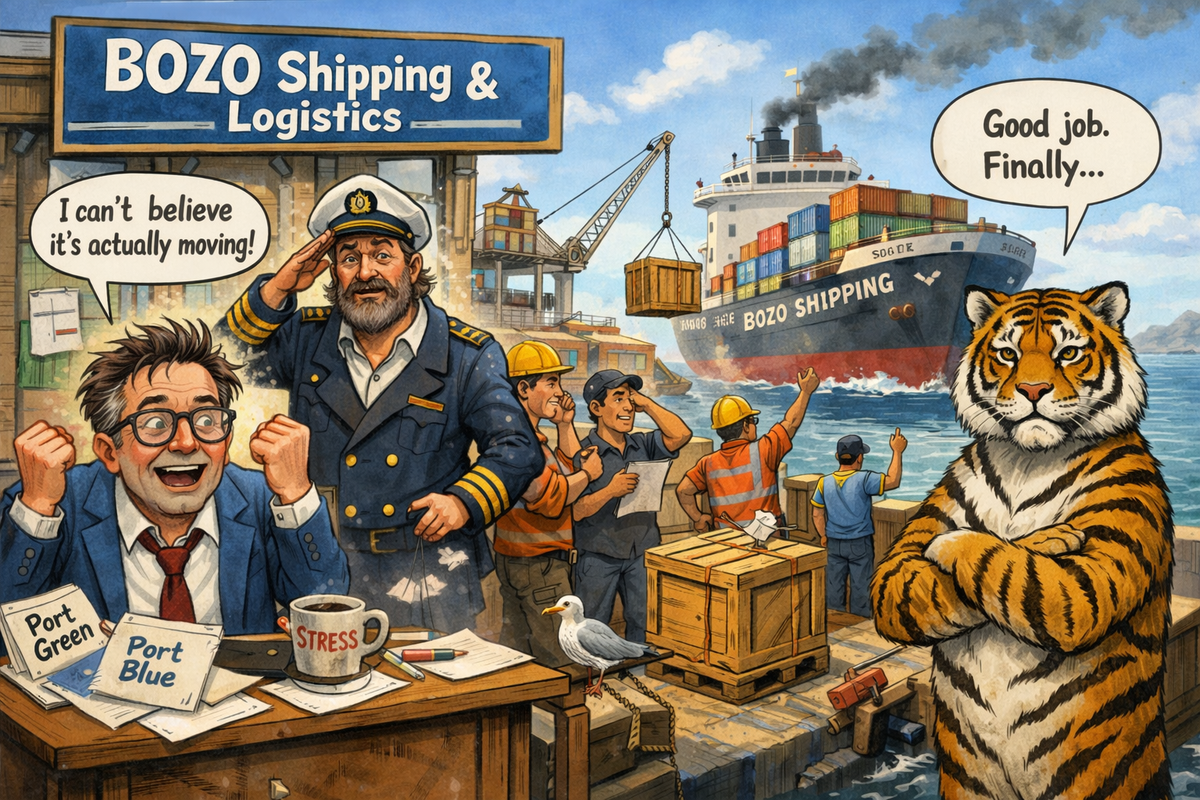
At precisely this moment, the tiger walked through the yard.
Mr. Sheru did not announce himself. He did not need to. Conversations thinned. Movements sharpened. The man writing notes suddenly found clarity. The rope inspector discovered urgency. The crate, which had until now been treated like a fragile diplomatic situation, was approached with actual intent.
Sheru stopped beside the crate and looked at it once.
This was enough.
“Lift,” said one of the men, suddenly fluent in action.
The crate moved. It did not resist. It had never resisted. It simply needed to be believed in.
Upstairs, Mr. Ozo sensed a shift, the way one senses rain before it arrives or panic before it speaks. He looked out of the window and saw something he had not seen in a while.
Work.
“Captain,” he said, almost whispering, “they are… working.”
Captain Crank adjusted his cap, narrowed his eyes, and nodded as though he had orchestrated this with quiet brilliance. “Momentum,” he said. “Very important in maritime culture.”
The ship, Vessel 17, stood at the dock with the patient dignity of something that had seen better organisations. The loading began. Slowly at first, then with a rhythm that suggested the possibility of continuity. Boxes moved. Lists were checked. Someone even used a trolley correctly, an event so rare it nearly required documentation.
Of course, BOZO could not allow such progress to remain uncomplicated.
At 10:47, a man ran into the office holding a paper that had clearly lived a difficult life.
“Sir,” he said, “this says the cargo is for Port Blue.”
Mr. Ozo nodded. “Yes.”
The man swallowed. “The ship is scheduled for Port Green.”
Silence entered the room and sat down.
Captain Crank looked thoughtful. “Colours are… interpretive,” he offered.
Mr. Ozo closed his eyes for a moment, not in defeat, but in negotiation with reality. When he opened them, there was something new in them. Not clarity. Not control. But a certain willingness to continue anyway.
“Can we redirect?” he asked.
“Of course,” said the captain, with the confidence of a man who had not yet considered how.
Below, Sheru had already begun the quiet process of adjustment. A few instructions, a few looks, a redistribution of effort that did not announce itself but rearranged the day. The crate that was going to Blue was now moving toward a solution that did not involve embarrassment.
By 11:32, something remarkable happened.
The ship moved.
Not dramatically. Not with cinematic grace. But with honest, mechanical intent. It edged forward, as if testing whether the day was serious. The water accepted it. The ropes were released. The crew stood with a mixture of pride and disbelief, as though they had collectively completed a group project they had all planned to postpone.
In the office, Mr. Ozo sat down slowly.
“We did it,” he said.
Captain Crank looked out at the departing vessel, then back at Mr. Ozo. “We nearly did it,” he corrected, kindly.
And that was enough.
Down below, the staff allowed themselves small smiles, the kind that arrive when effort accidentally produces results. The man with the notes wrote something meaningful for the first time. The rope inspector shook the rope’s hand, metaphorically. Someone opened a packet of biscuits, not as an escape, but as a celebration.
Sheru watched the ship until it was no longer the company’s immediate responsibility. Then he turned and walked back through the yard, his work done, his silence intact, his presence already being converted into stories that would grow larger by the afternoon.
At BOZO Shipping & Logistics, the ship had not just moved.
Hope, slightly dented but still operational, had moved with it.
And tomorrow, with absolute certainty, they would try again.