
BOZO 4: The Day the System Was Introduced
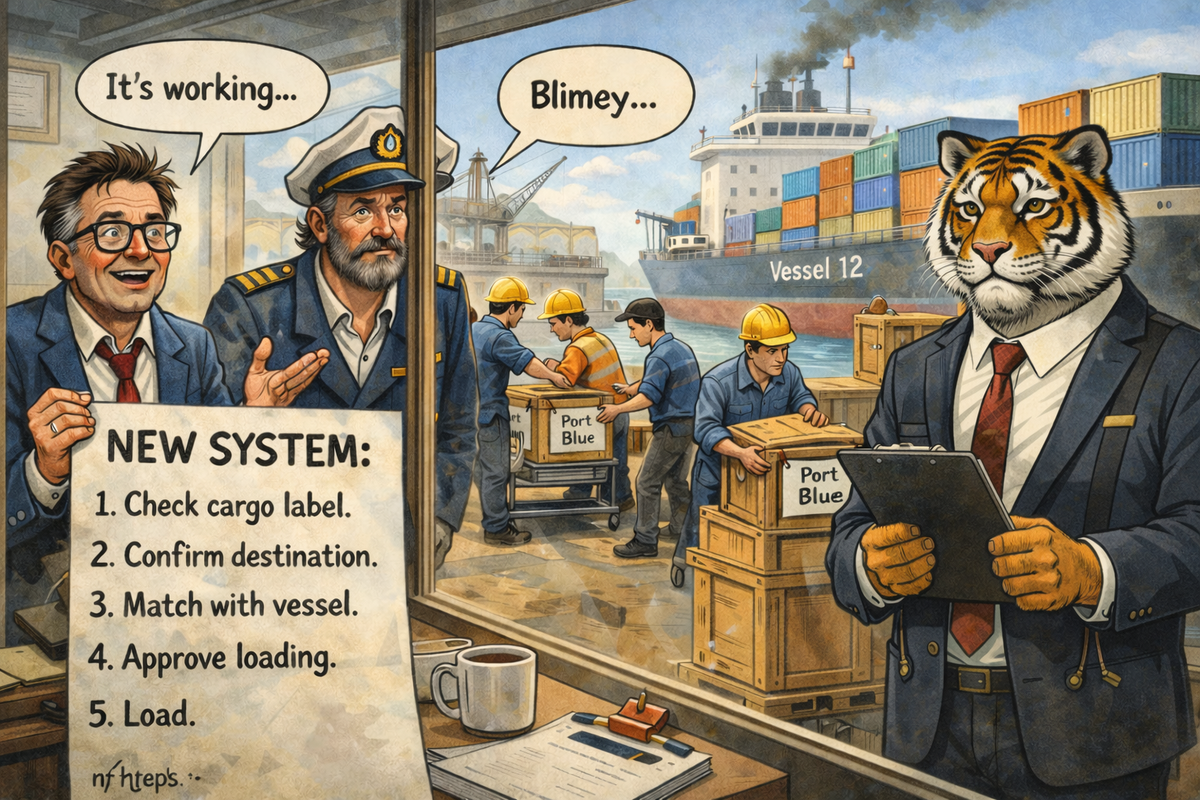
There comes a moment in every organisation when someone says, with great seriousness and mild danger, “We need a system.” At BOZO Shipping & Logistics, this moment arrived at 9:42 a.m., slightly late, slightly uncertain, but carrying the full weight of intention. Mr. B.L. Ozo stood in the middle of the office holding a printed sheet. It was not an ordinary sheet. It had boxes. It had headings. It had lines that expected to be filled. It had, in short, structure. “From today,” he said, with a voice that hoped to be remembered, “we follow a system.” The room reacted the way a group reacts when introduced to vegetables at a celebration. There was respect. There was hesitation. There was a quiet search for alternatives. Captain Bartholomew Crank examined the sheet from a safe distance. “It looks organised,” he said, with cautious admiration. “Yes,” said Mr. Ozo, encouraged. “That is the idea.” The system was simple. Almost suspiciously simple. Step 1: Check cargo label. Step 2: Confirm destination. Step 3: Match with vessel. Step 4: Approve loading. Step 5: Load. It was five steps. Five clear, well-behaved steps. Steps that did not require interpretation, philosophy, or biscuits. Naturally, this created immediate discomfort. On the ground, the staff gathered around the first printed copy as though it were a new species. “Do we follow this… in order?” one asked. “That seems to be the intention,” said another, reading the numbers as if they might rearrange themselves under pressure. A third man nodded slowly. “Sequential,” he said, discovering the word like a hidden talent. The man with two pens took the lead. He had been waiting for a moment like this his entire career. “Let us apply,” he said, with quiet authority. A crate was selected. Not because it was urgent, but because it was nearby and had a cooperative appearance. Step 1: Check cargo label. They checked. The label existed. It was readable. This alone felt like progress. Step 2: Confirm destination. “Port Blue,” said one. “Confirmed,” said another, writing it down with ceremony. Step 3: Match with vessel. They paused. This step required movement. One man walked to the schedule board. He stared at it. The board stared back. “Vessel 12,” he announced finally. There was a moment of pride. A step had been completed with effort and without snacks. Step 4: Approve loading. “Approved,” said the man with two pens, before anyone could complicate it. Step 5: Load. The crate moved. Not dramatically. Not heroically. But correctly. Upstairs, Mr. Ozo was watching. His face did not show joy immediately. BOZO had trained him to be cautious with hope. But there was something in his eyes. A small, steady flicker that suggested belief might be returning on a trial basis. “Captain,” he said softly, “it is working.” Captain Crank adjusted his cap, observing the scene with thoughtful seriousness. “Yes,” he said. “It appears the system is… being followed.” He said it like a man witnessing a rare natural event. Below, the staff experienced something unfamiliar. Flow. One crate became two. Two became four. The steps repeated. The numbers held. The process, which had looked like a polite suggestion on paper, was now moving through the yard like a quiet discipline. Of course, BOZO could not accept this without testing it. At 11:08, a crate arrived without a label. The system paused. Five steps stood in front of them like a staircase missing its first step. “What do we do?” asked one. They looked at the sheet. Step 1: Check cargo label. There was no label. This was new territory. The man with two pens held the paper closer, as if proximity might generate instructions. Captain Crank, sensing a moment of leadership, stepped forward. “When the system cannot begin,” he said, “we must… enable the beginning.” No one fully understood this, but it sounded like direction. Sheru arrived. He looked at the crate. He looked at the absence of a label. He looked at the men. Then, without ceremony, he picked up a marker, wrote “Port Green” on a piece of paper, and attached it to the crate. Step 1 was now possible. The system resumed. The crate moved. And just like that, BOZO learned something it had never quite practiced before. Not perfection. Not brilliance. But continuity. Upstairs, Mr. Ozo sat down slowly. He placed the system sheet on the table and looked at it not as a document, but as a quiet ally. “We have a system,” he said, almost to himself. Captain Crank nodded. “Yes,” he said. “And today, it did not argue with us.” In the yard, the staff continued, not with excitement, but with a growing comfort that effort did not always have to be negotiated. That clarity did not always have to be debated. That five steps, when respected, could move more than crates. They could move people. Sheru walked through the space once more, not checking, not correcting, just observing. The system was not perfect. The people were not perfect. But for the first time, they were not working against each other. At BOZO Shipping & Logistics, this was not just a good day. It was a structured one. And that, for this organisation, felt almost revolutionary.