Flopocalypse Now: Fish Walk, Humans Drown
You wake up with gills. Your Tesla is a coral reef. The pufferfish outside your window looks hungry.That is Day One of Flopocalypse Now
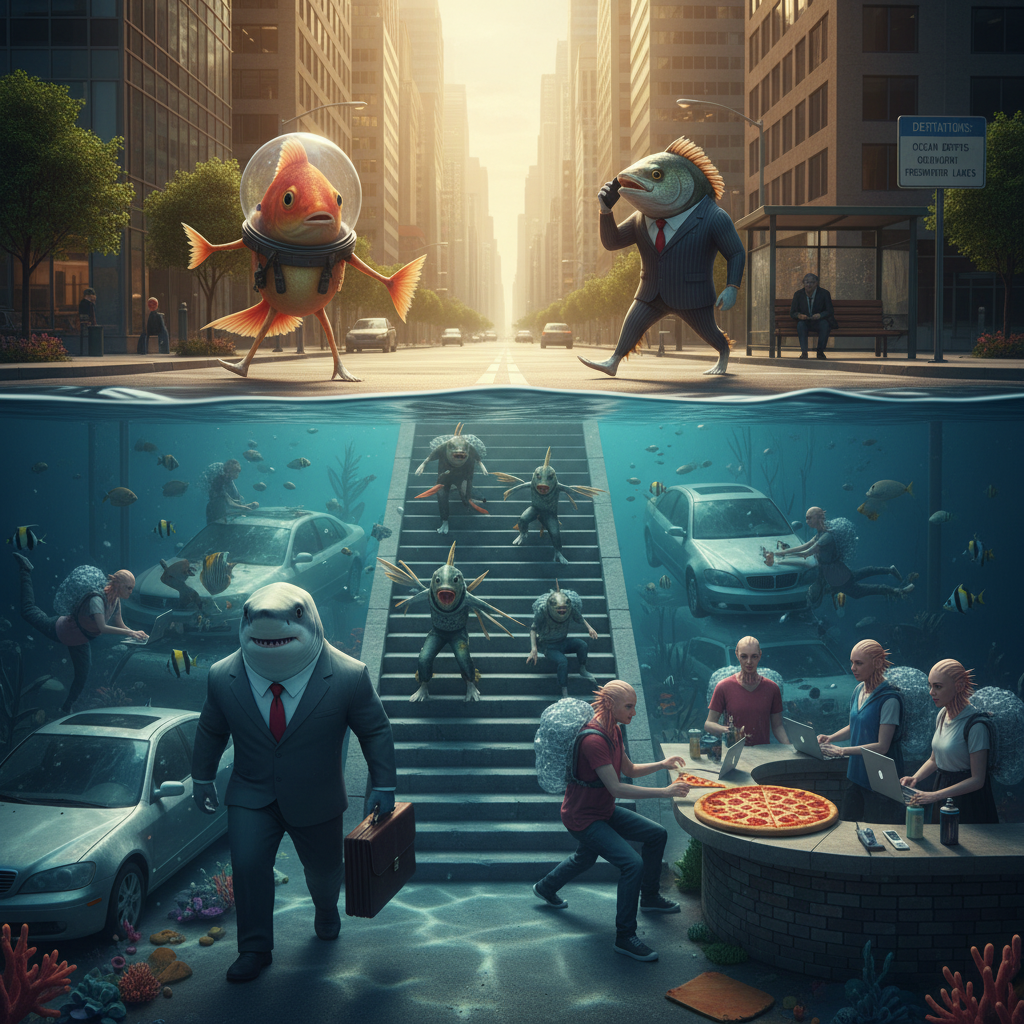
You wake up with gills. Your Tesla is a coral reef. The pufferfish outside your window looks hungry.That is Day One of Flopocalypse Now—a world where humans can only survive underwater, and fish have taken over the skyscrapers.When sea level isn’t the problem, it’s the addressYour old life is still there, just… submerged.
Apartments, offices, and cafés have become flooded dioramas. Chairs float. Keyboards drift. Calendars peel slowly off the walls. You slide out of bed, realise your toes are webbed, and discover that breathing air now feels like swallowing dust. The only place your lungs relax is under the surface.Outside, the streets are deep channels between high-rises.
Your car sits on the road like an abandoned prop in an aquarium, slowly collecting coral and confused clownfish. If you live in Bangkok, the Chao Phraya River has stopped being a commute and become a postcode. Your living room is water. Your front door is technically a dock.You try to work from home, but “the sharks ate my homework” is suddenly a valid sentence. So is “the current took my router.”
Coffee exists, but it’s mostly warm saltwater with a hint of dissolved anxiety.Dating, gyms, and food delivery at the bottom of the cityOnce the first wave of panic settles, underwater society does what societies always do: it reforms, badly and creatively.
Dating apps pivot overnight. Bios now read: “Six‑foot‑two with functional fins, good lung capacity, looking for someone to Netflix and never chill because electricity kills us.” Profile pictures are all slightly blurry because holding still in three dimensions is harder than it looks.Gyms survive too.
Gym bros spot each other while bench‑pressing rusty anchors. A casual deadlift now includes calculating water resistance and the risk of being photobombed by an octopus.Food delivery turns into a gladiator sport called JawDash. The “drivers” are barracudas. Tracking your order means watching a fast‑moving dot on a sonar map and hoping it’s your curry, not your neighbour’s. The good news: five‑star delivery is almost guaranteed. The bad news: so is the bite mark.
Workplace culture adapts. Performance reviews now include phrases like “handled electric‑eel incident with composure” and “excellent stakeholder management with territorial stingrays.”
Meanwhile, on land: fish discover stairsUp above, the air is back in fashion.Fish are no longer confined to glass tanks and oceans. They’ve evolved lungs, or at least very good wetsuits, and they’ve moved into our cities like they were always meant to be there. Your old neighbourhood hasn’t vanished; it has been gentrified by marine life.Goldfish live in tiny condos, staring out of windows and yelling at smart speakers to play “Bubble Guppies” ironically. Tuna executives in sleek power fins rush between meetings, yelling “buy low, sell krill” into their headsets. Sharks have become actual real‑estate sharks, selling your former beach flat as “a rare opportunity to invest in premium dry square footage.”The food chain has been inverted and stapled to a lease agreement.Still, their new empire has one major enemy: stairs.Office lobbies, subway entrances, and fire escapes were all designed by creatures with knees. For a body built to glide, every step is a negotiation with gravity. Stairs turn corporate climbers into slapstick performers. A swordfish with road rage is one thing; a swordfish on a staircase is a building‑code violation.
Drive‑thrus multiply to avoid this problem. McCod’s opens on every corner so fish can slide up, shout an order, and ooze away without ever climbing a single step. Infrastructure becomes the real battlefield.
Human SEAL teams and UN Bubble TalksWhere there’s friction, there’s politics.Underwater, humans form elite rebel units called Human SEAL teams—Sea Eel Assault League. Their missions: quick raids to the surface to steal dry socks, salvage power banks, and maybe grab a pizza before getting chased off by inflated pufferfish gangs.Diplomacy takes the form of UN Bubble Talks held at neutral depths where oxygen levels are negotiable. Fish demand reparations for generations of tuna melts and fish fingers.
Humans file counter‑claims for every “harmless nibble” that turned into a blood‑drawing toe incident in Phuket.Skirmishes are messy and comic. Raids for takeaway food end with flustered humans retreating underwater, dropping slices as they go. Pufferfish roll after them like spiky tumbleweeds of law enforcement.It isn’t quite war, but it’s more than a misunderstanding. It’s a prolonged argument over whose habitat was taken more for granted.SinkCoin, shark spas, and the Shark BowlEconomies, being allergic to empty space, immediately fill the new world with nonsense.Humans launch a cryptocurrency called SinkCoin, marketed as “the only asset guaranteed to go down.” Influencers post filtered photos of their bubble‑wrap armour with captions about “staying liquid.” Someone inevitably starts a podcast.Fish entrepreneurs open upscale spas that advertise “full‑body human oil treatments.” Nobody reads the small print. Nobody wants to.Sports adapt too. The Super Bowl becomes the Shark Bowl, played in a flooded stadium where half the spectacle is seeing who accidentally bites the ball. Instead of confetti, red chum falls gently at halftime, and no one is entirely sure if it’s part of the show.Music charts shift. “The Beatles” rebrand as “The Beat‑els,” a collective of musicians who perform alongside actual electric eels providing live, buzzing basslines.Every corner of this wet civilisation proves the same thing: given enough time, we will monetise our own disasters.
What this silly world is really pointing atTake away the pufferfish gangs and the krill‑obsessed stockbrokers, and Flopocalypse Now is making a quieter point.We only notice some of our biggest advantages when we lose them. Legs. Dry stairs. Rooms where paper doesn’t dissolve. Habits that don’t require buoyancy calculations.In this flipped world:Humans discover how fragile their comfort really was—one element (air) changes, and everything must be redesigned.Fish inherit the symbolic top of the food chain and realise power doesn’t remove clumsiness. Dominance doesn’t fix stairs.Both sides improvise tools, treaties, currencies, and costumes just to feel less out of place.The apocalypse here isn’t fire and ruin. It’s a wet inconvenience that forces everyone to see how much of “normal life” is propped up by unnoticed scaffolding.Questions for your inner sea creatureIf you want to squeeze something practical out of this nonsense, try sitting with these:In your real day‑to‑day, what’s your staircase—the ordinary thing you barely notice that quietly holds your world together?If your environment flipped suddenly (new role, new city, new market), what kind of “bubble‑wrap armour” would you build for yourself? Tools, habits, allies?When have you been the “shark in a suit”—officially powerful, but secretly clumsy and out of your depth? What did that teach you?
Flopocalypse Now isn’t really about fish winning and humans losing. It’s about how ridiculous all of us look when the script changes—and how much grace we might need, for ourselves and each other, while we learn to swim in a life that suddenly forgot what land was for.