Gajendra Moksham
Gajendra Moksha is not just a mythological episode tucked away in the Bhagavata Purana; it feels more like a quiet conversation between human suffering and divine grace, told through the life of an elephant king. At its heart, the story asks a simple but unsettling question: what happens when strength, status, and support all fail at once? Gajendra’s story answers that question not with philosophy, but with lived experience, exhaustion, and finally, surrender.
Gajendra lived a life many would envy. As the king of elephants on Mount Trikuta, his days were full, abundant, and unthreatened. He moved with power, surrounded by his herd, enjoying the pleasures of nature without fear. The lake he visited was not just a place to drink but a space of ritual and offering, where he plucked lotuses for Lord Vishnu. There was devotion, but it lived comfortably alongside strength and security. Nothing suggested that such a life could suddenly tilt into helplessness.
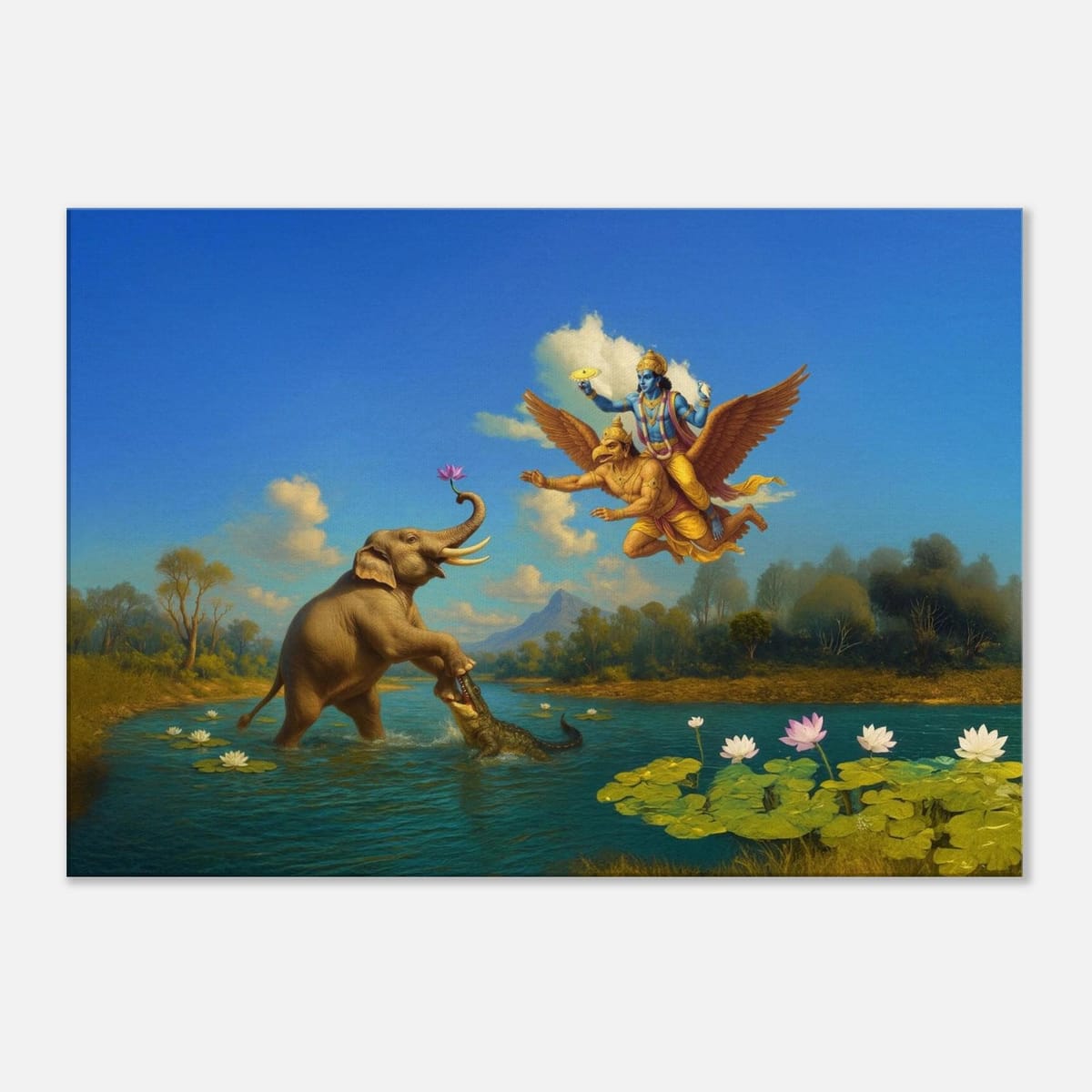
That illusion shattered the moment the crocodile seized his leg. What followed was not a brief struggle but a long, draining conflict that stretched across years. Gajendra fought with everything he had, pulling with the force of land against water, refusing to yield. Yet the longer the struggle continued, the clearer it became that brute strength alone could not decide the outcome. Slowly, power slipped away, not dramatically, but through fatigue, repetition, and despair.
At first, Gajendra was not alone. His family and companions gathered, trumpeting, pushing, attempting to help. But time wears down even loyalty. One by one, they retreated, not out of cruelty, but because reality had become undeniable. This abandonment is one of the story’s most human moments. It mirrors how, in our own crises, even well-wishers eventually step back, leaving us face-to-face with our limits.
Exhausted beyond resistance, Gajendra reached a point where effort itself became meaningless. It was here, at the edge of defeat, that memory surfaced. From a past life, a prayer returned to him, unforced and uncalculated. Lifting a lotus with his trunk, he called out to Vishnu, not with strategy or expectation, but with complete surrender. This was sharanagati, not as an idea, but as a lived necessity.
Vishnu’s response was immediate. There was no delay, no test, no weighing of merit. He appeared and ended the struggle in an instant, freeing Gajendra by striking the crocodile with his discus. The speed of divine compassion stands in contrast to the long suffering that preceded it, reminding us that grace does not always follow human timelines, but it never misses a sincere call.
Liberation followed rescue. Gajendra was not merely saved; he was transformed. Granted sarupya mukti, he attained a divine form and was taken to Vaikuntha. Gajendra Moksha leaves us with a quiet reassurance: when all outer strength collapses, inner surrender can still open the door to freedom. Not because we are powerful, but because compassion listens.