GALLE, SRI LANKA — WHERE THE OCEAN TEACHES YOU HOW TO BREATHE AGAIN
Some places don’t announce themselves loudly. They don’t try to impress. They don’t chase attention. They simply exist—calm, confident, and complete. Galle is one such place. It doesn’t ask you to fall in love with it. It lets you arrive tired, uncertain, carrying the weight of too many cities, and then quietly reminds you how light life can feel.
Galle is not just a destination. It is a pause. A long, deliberate pause between who you were and who you are slowly becoming.
The first thing you notice is the ocean. Not the kind that demands adrenaline or spectacle, but the kind that speaks in steady rhythms. Waves that don’t shout, but repeat themselves patiently, as if teaching the nervous system how to calm down. The air smells of salt, old stone, rain, and history. And suddenly, without effort, your breath deepens.
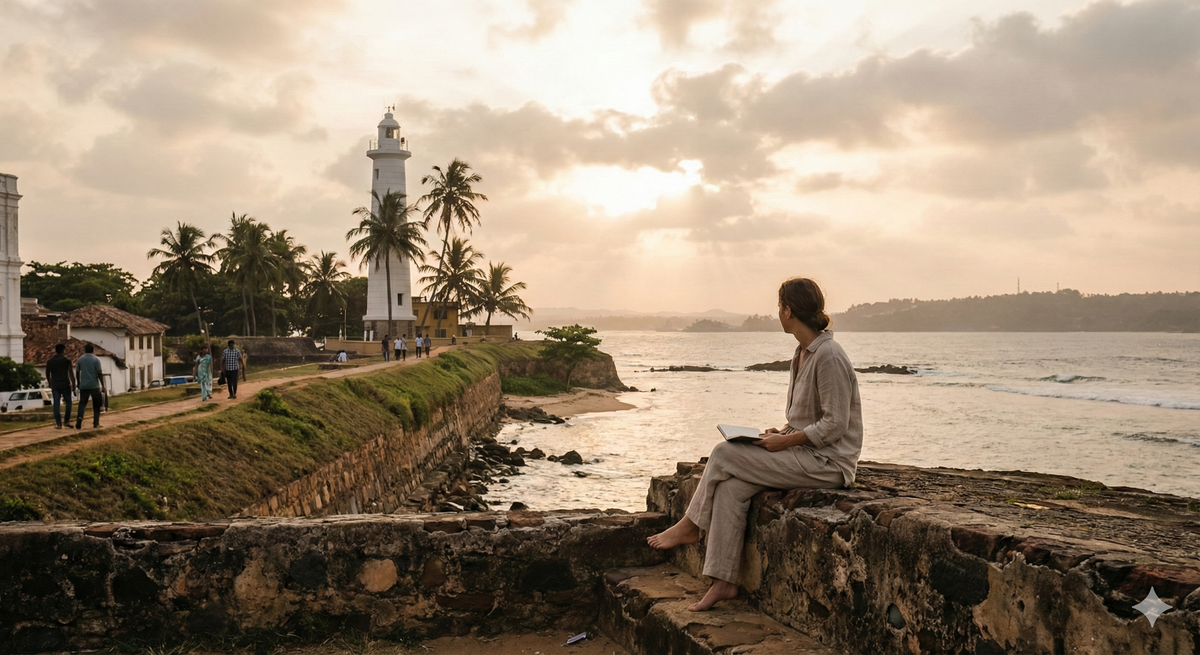
Tourists come to Galle for many reasons. Some arrive chasing postcards—the iconic lighthouse, the curved ramparts of the Dutch Fort, the sunset walks where the sky turns gold and bruised purple. Others come for the beaches nearby—Unawatuna, Dalawella, Thalpe—each with its own personality. But what keeps people longer than planned is not the scenery. It’s the feeling of being unhurried.
Galle has history layered gently into everyday life. The fort walls do not dominate; they observe. They’ve seen empires arrive and leave, storms come and pass, people fall and rise again. Walking through the narrow streets, past colonial buildings now turned into cafés, bookstores, yoga studios, and quiet homes, you feel time slow down. Not in a nostalgic way—but in a humane one.
This is why Galle attracts a very specific kind of long-stay expat. Not the loud, restless type chasing excess, but the thoughtful ones. Writers. Designers. Remote workers. Burnt-out entrepreneurs. Couples taking a break from fast cities. Solo travelers who arrived for a week and stayed for months. People who are not running away from life, but relearning how to live it.
Here, expats blend rather than dominate. Mornings begin with coffee overlooking the sea, laptops open but not enslaving. Afternoons drift between swims, conversations, reading, or long walks on the fort walls. Evenings unfold slowly—sunsets first, decisions later. There is a shared, unspoken understanding among those who stay: no rush, no performance, no pretending.
Nature in and around Galle feels generous. Palm trees lean casually, as if unconcerned with productivity. Monkeys move freely, unbothered by human schedules. The ocean is both playground and teacher. The rain arrives without warning and leaves just as suddenly. Everything feels alive, but not aggressive.
One of the quiet miracles of Galle, especially in the present time, is the sense of freedom and safety it offers. You can walk at night without constant vigilance. You can sit alone without being disturbed. You can exist without explanation. There is space here—for thought, for rest, for recovery. In a world where safety often comes with tension, Galle offers safety with softness.
The cost of living is another reason people stay longer than planned. Life here is affordable without feeling compromised. Fresh food is abundant. Local meals are nourishing and inexpensive. Comfortable stays—from guesthouses to boutique rentals—offer value that feels fair, not inflated. You don’t need to hustle just to survive. And that changes how you relate to your days.
Then there is the party culture—but not the chaotic, destructive kind. Galle’s nightlife is selective, seasonal, and soulful. Beach parties that appear under moonlight and disappear by dawn. Music that feels communal rather than commercial. Dancing that feels like release, not escape. Alcohol exists, yes, but it doesn’t define the night. Conversation, connection, and the ocean breeze do.
What makes Galle special is balance. You can be social without being overwhelmed. You can be alone without feeling lonely. You can celebrate without losing yourself. Few places manage this equilibrium.
Most importantly, Galle gives people permission—to slow down, to feel again, to listen inward. It doesn’t push transformation. It allows it. People leave Galle lighter, not because their problems vanished, but because their relationship with life softened.
In a time when the world feels loud, divided, and demanding, Galle stands quietly by the sea, offering something radical: a life that does not need constant explanation.
And for those who arrive exhausted, unsure, or simply curious, Galle does not promise answers. It offers something better.
Space.
Safety.
Rhythm.
And the gentle reminder that freedom does not always look like speed—sometimes, it looks like stillness by the ocean.
Galle waits patiently.