Greats by JUPARS: The Man Who Wanted to Know Everything - ARISTOTLE
Greats by JUPARS: The Man Who Wanted to Know Everything - ARISTOTLE
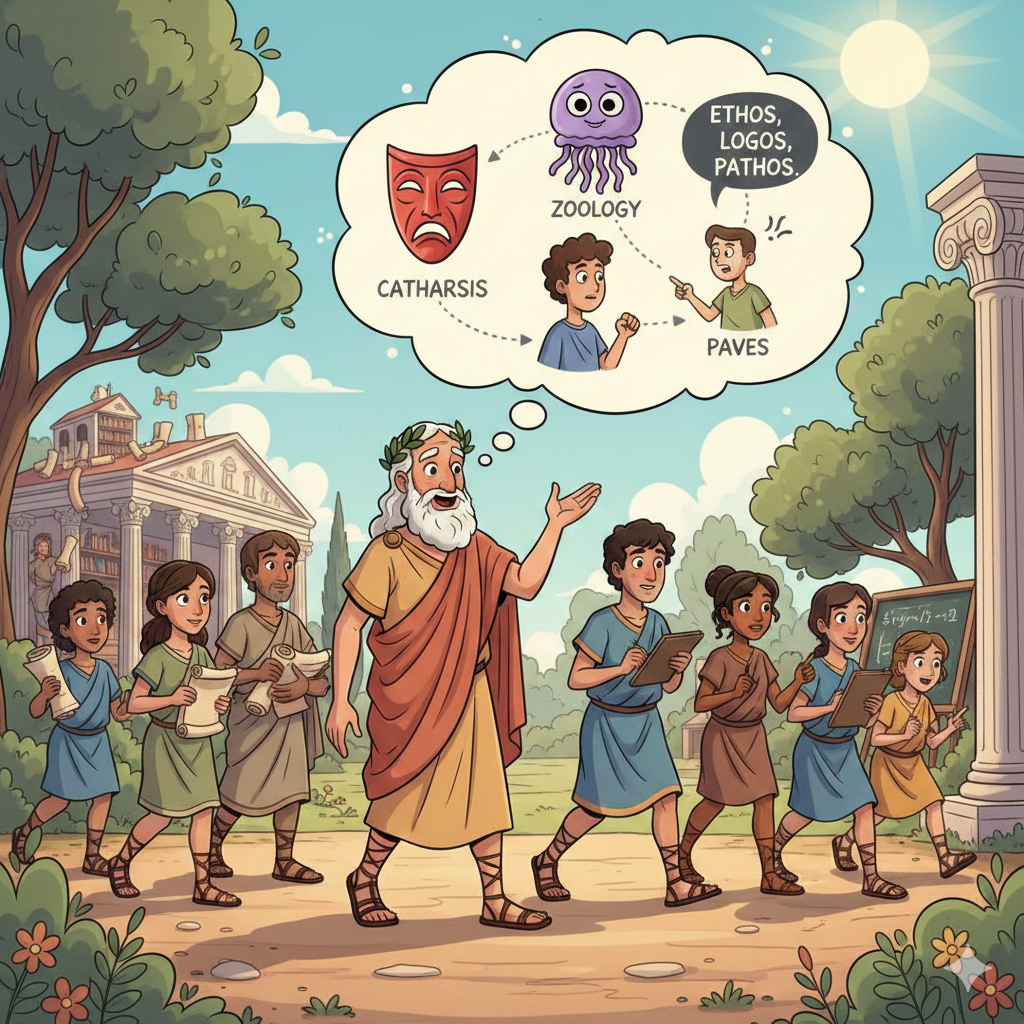
In 384 BCE, in the salt-aired town of Stagira, a boy was born who would eventually try to catalog the entire universe. We know him as Aristotle, but to his contemporaries, he was the "Reader"—a man whose hunger for data was so ravenous it changed the trajectory of human history. From Star Pupil to Rebel At seventeen, Aristotle landed in Athens at Plato’s Academy. Imagine the intellectual sparks: Plato, the idealist who looked at the heavens for truth, and young Aristotle, who kept looking down at the dirt, the plants, and the rhythmic pulse of the sea. While Plato believed this world was just a "shadow" of a higher reality, Aristotle was the ultimate realist. For him, truth wasn't hiding in another dimension; it was right here, waiting to be measured, touched, and understood. This tension—the clash between the Ideal and the Observed—is the heartbeat of Western thought. The Peripatetic Life: Philosophy on the Move Aristotle didn't like sitting still. When he founded his own school, the Lyceum, he became famous for his "peripatetic" (walking) teaching style. Imagine a brisk morning in Athens: a group of students scrambling to keep pace with a middle-aged man who is simultaneously explaining why a tragedy needs a "catharsis" and how to classify a jellyfish. He wasn't just lecturing; he was building the world’s first great research station. He collected specimens, organized the first major library, and taught his students that virtue isn't a thought—it's a habit. Why He Still Matters (Beyond the History Books) Aristotle’s "Nicomachean Ethics" isn't a dusty set of rules; it’s a manual for adulting. He gave us the "Golden Mean," the idea that the best way to live is to find the sweet spot between extremes. * Cowardice is too little courage. * Recklessness is too much. * Bravery is the perfect middle. He also decoded how we persuade one another. Every time you watch a politician, an advertisement, or a viral video, you’re seeing his "Rhetorical Triangle" in action: * Ethos: Do I trust you? * Logos: Does your argument make sense? * Pathos: Do you make me feel something? The Legacy of the "Master of Those Who Know" When Aristotle died in 322 BCE, he didn't just leave behind scrolls. He left a method of thinking. He taught us that the world is a puzzle that can be solved if we are patient enough to look at the pieces. He was the bridge between the ancient myths and the modern laboratory. More importantly, he was a human being who believed that our greatest purpose—our telos—is simply to flourish. Two thousand years later, we’re still trying to keep up with his pace.