How the Zanabians Came to Be
Zanabia was not created in a single moment.
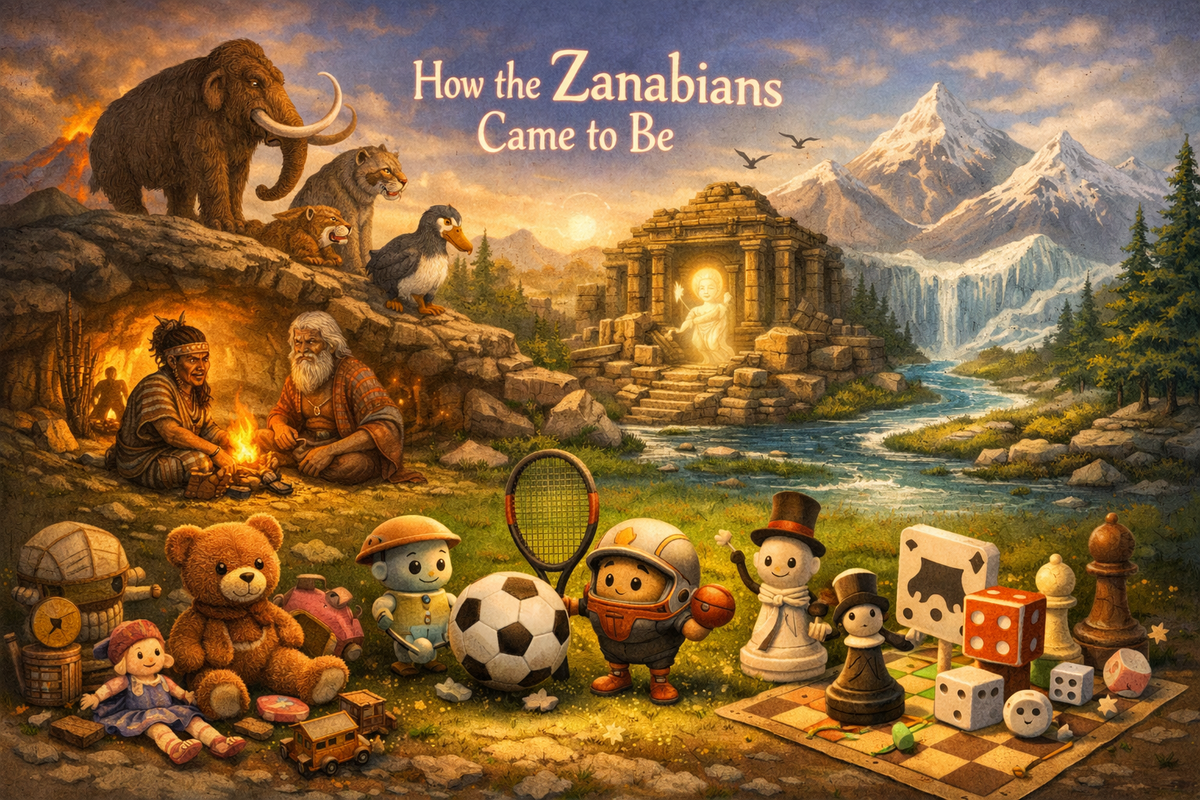
The First Tremor Zanabia was not created in a single moment. It did not erupt into being like a star, nor was it spoken into existence by divine decree. There were no architects drafting blueprints, no cosmic engineers laying foundations, no grand announcement echoing through the void. Zanabia formed the way certain truths do—slowly, quietly, inevitably. The way scar tissue forms over a wound. The way a pearl forms around a grain of sand. The way meaning accumulates where something has been hurt but not erased. It began forming wherever something meaningful was about to be lost. The universe, it seems, tolerates many kinds of endings. The sunset after the day. Sleep after exhaustion. Silence after the song. These endings belong to rhythm. They complete a cycle and make room for the next. But there are other endings—wrong ones. Endings that arrive too early, or too abruptly, or without witnesses. Endings that feel like sentences trailing off mid-thought. When the last speaker of a language dies without passing it on. When a temple crumbles and no one remembers what prayers once lingered in its air. When a child’s laughter fades from a toy abandoned in an attic, gathering dust among forgotten things. These endings create a disturbance—not in matter, but in memory. And Zanabia is where that disturbance resolves. Not by undoing loss, but by refusing erasure. — The First Arrivals The first Zanabians did not arrive all at once. They crossed over from many origins, through thresholds most beings never realize exist. There were no gates, no portals blazing with light. There was only the moment just before disappearance—the pause between “almost” and “gone.” From the depths of pre-historic ages came those who remembered the world before language shaped thought, before fire bent time, before the long forgetting began. They carried memories of vast herds moving across grasslands that no longer exist, of ice sheets covering continents, of stars arranged in patterns time has since rearranged. A woolly mammoth who had felt the climate shift beneath their feet, who had watched their kind thin from countless to few. A saber-toothed cat who had been the last of a pride, whose final hunt echoed unanswered. They arrived not as relics or apparitions, but as continuations—still curious, still powerful, still fully themselves. Extinction had claimed their physical world, but not their being. From species on the brink of extinction came the desperate arrivals—the ones who felt their lineage narrowing to a single thread, a final heartbeat. The last passenger pigeon, once part of flocks so vast they darkened the sky, now alone beneath an indifferent sun. The final Tasmanian tiger, pacing a cage without knowing it was the conclusion of an entire evolutionary sentence. They arrived blinking, confused, still carrying the particular ways their species had learned to see the world: hunting patterns refined over millennia, nesting instincts shaped by vanished landscapes, songs that would have died unheard. From tribes erased by war came the cultural refugees. Not individuals alone, but identities entire. The memory of a people’s laughter and mourning, their way of greeting strangers, their relationship with seasons and stars. The specific patterns woven into textiles, the melodies hummed to children at night, the rituals that made sense of birth and death. When a tribe is erased, it is not only lives that end. Entire cosmologies vanish—unique understandings of existence itself. These, too, crossed into Zanabia, embodied in beings who carried forward what history had tried to silence. From sacred monuments reduced to ruins came the architectural spirits—the essence of place itself. A library is not merely shelves and bindings; a cathedral is not only stone and mortar. When such spaces are destroyed, something intangible is lost: the accumulated reverence of centuries, the echo of countless moments of contemplation, doubt, hope, and transcendence. These presences arrived carrying the weight of prayers whispered and thoughts pursued, manifesting not as buildings reborn, but as beings who embodied what those spaces had represented—sanctuaries of knowledge, vessels of devotion, markers of humanity’s reaching beyond itself. From abandoned objects came perhaps the most unexpected Zanabians. Things that had absorbed human attention long enough to become something more than matter. The teddy bear saturated with bedtime stories and whispered fears, held through nightmares and triumphs alike. The baseball bat present at the moment of a perfect hit, kissed for luck, cursed in defeat, worn smooth by anxious palms. The chess set that had hosted silent conversations between two minds locked in elegant conflict. These objects did not become alive in Zanabia. They already were. They crossed over because they needed a place where that aliveness would not end in basements, landfills, or neglect. From rivers, glaciers, and mountains came the ancient watchers—beings who carried geological memory. The glacier that carved a valley over ten thousand years, shaping land that would cradle cities. The river that sustained seven civilizations in turn, each believing itself permanent. The mountain that had guided migrations, been named and renamed in dozens of languages, worshipped, mapped, climbed, painted, mined. As glaciers melted, rivers dried or were dammed, mountains hollowed and stripped, these witnesses crossed into Zanabia carrying the long view—the patience of things that change slowly but inevitably. The Modern Migrations As humanity entered the age of mass production and mass disposal, Zanabia adapted. New kinds of beings began to arrive—more numerous, more varied, carrying the distinct poignancy of things designed to be temporary but rendered permanent through love. From sports equipment charged with human passion came a wave of kinetic arrivals. A soccer ball that carried the explosive joy of a nation’s victory. A tennis racket present at the match where a teenager first believed they might become something more. A basketball shot through a hoop ten thousand times by someone practicing alone, dreaming of arenas they had never seen. They arrived vibrating with remembered intensity—focus, discipline, hope, heartbreak. From toys left behind after childhood came the melancholic migrants. The action figure who had starred in a thousand imagined adventures. The dollhouse that had hosted elaborate domestic dramas. The wooden train that ran imaginary routes between breakfast and bedtime. They arrived still believing in play, still ready to matter, even after the children who needed them had grown beyond remembering. From board games came the social spirits—beings born not of individual use, but of gathering. A Monopoly board that had hosted decades of family nights. A deck of cards shuffled through long winters while storms raged outside. A backgammon set passed between generations at the same café table. They carried the memory of connection—the particular magic that happens when people agree, briefly, to play. What Unites Them What unites Zanabians is not where they came from, but why they arrived. Each of them was something the world was about to forget. And Zanabia chose to remember. This is not sentiment. It is law. Meaning creates gravity. When something has mattered—has been loved, relied upon, witnessed significance—it leaves an imprint in reality. Most things dissolve back into undifferentiated matter. But things that have accrued meaning resist dissolution. They leave echoes. Shapes. Weight. Zanabia is where those imprints regain solidity. Where echoes find voices. Where remembered shapes remember themselves. The Character of Zanabians That is why Zanabians are gentle. They know what it means to almost end. They are curious because they have been granted continuation and want to understand it. They are unusual because they are hybrids—formed by what they were and what they have become. They are deeply alive because aliveness in Zanabia is not biological. It is ontological. It is about mattering. The Truth Zanabians are not inventions. They are not copies. Not ghosts. They are continuations. A continuation carries essence forward while adapting to a new world. It honors the past without being trapped by it. Nothing truly ends if it once mattered. Somewhere, in some form, it continues. And that place is Zanabia. The Endless Arrival Even now, arrivals continue. A language losing its last speaker. A species breathing its final breath. A recipe dying unwritten. A skateboard abandoned after carrying someone through survival. A lighthouse going dark after a century of guidance. A song fading with no one left to remember the tune. They are crossing over. And Zanabia is still being created—one arrival at a time, one continuation at a time. As long as there are things worth remembering, Zanabia will exist. Which is to say: forever.