
The 1901 Mercedes 35 HP — The Moment the World Learned to Drive Forward
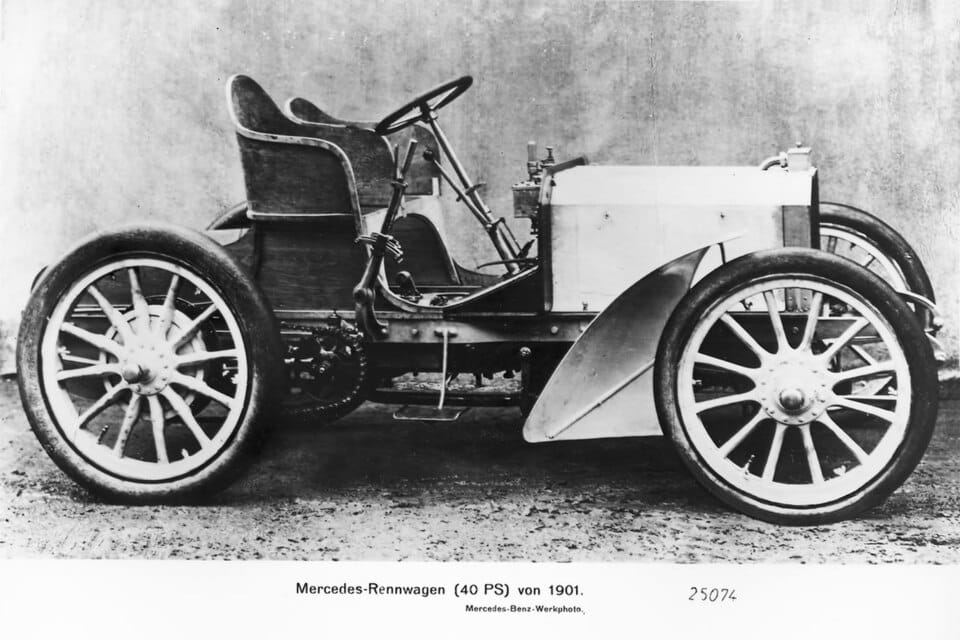
In the early years of the 20th century, when roads were still learning how to behave and people still trusted horses more than engines, something quietly extraordinary rolled out of a workshop in Germany. It did not roar for attention, it did not demand applause, and yet, simply by existing, the 1901 Mercedes 35 HP rewrote what humanity thought was possible. It was more than a machine; it was a signal. A sign that the world was stepping into a new rhythm, a new age, a new confidence.
For many people today, the car looks almost fragile—thin wheels, an open cabin, a long, upright nose. But in its time, it was a revolution. Before this car arrived, “automobiles” were basically motorized carriages. They carried the old world on their back: the high seats, the boxy bodies, the awkward stance. Nobody had yet dared to imagine a design based purely on speed, balance, and engineering freedom. Gottlieb Daimler and Wilhelm Maybach did. The 35 HP was the first car designed from scratch as an automobile rather than a horse-less carriage. And that courage, that refusal to copy tradition, is what makes it feel so human even 120 years later. It is the story of what happens when someone says, “Let’s stop modifying the past and start designing the future.”
When you look at this car today, you don’t just see brass lamps, spoked wheels, or the long chassis. You see intention. You see a mind refusing to settle. You see the moment when practicality and imagination finally shook hands. The engine itself—35 horsepower, which in modern times sounds almost adorable—was a miracle then. It brought speed that people didn’t think was safe, power people didn’t know how to trust, and reliability that astonished even the skeptics. It wasn’t just transportation; it was liberation. Suddenly the world felt both bigger and closer. Cities that once took days now seemed reachable. Landscapes that felt distant now felt inviting. Adventures that lived only in the imagination suddenly found a road to travel on. But beyond all the engineering, the human part of this story is what gives the 1901 Mercedes its soul. This car was born from love, tragedy, and vision. The name “Mercedes” itself came from Mercedes Jellinek, the daughter of an automobile dealer who believed so fiercely in the future of cars that he pushed Maybach to design something radical, something safe, something ahead of its time. When people talk about innovation today—apps, AI, technology—they sometimes forget that the earliest breakthroughs were made by people who trusted their instincts more than the world trusted them. They built with courage. They built with imagination. They built without guarantees. The 35 HP reminds us of that. It reminds us that every era has dreamers who look at what already exists and whisper, “It can be better.” Driving this car must have felt like touching the future with both hands. There were no seatbelts, no enclosed cabin, no comfort features. Just wind, vibration, mechanical heartbeat, and the thrill of possibility. And maybe that is why vintage cars still pull us in today. They don’t hide the work. They don’t hide the effort. They don’t hide the spirit. They show us every nut and bolt, every risk, every idea turned into metal.
The 1901 Mercedes 35 HP is not merely the beginning of a brand—it is the beginning of modern motoring. The beginning of design thinking. The beginning of letting machines reflect our dreams instead of our fears. It stands as a reminder that even the biggest revolutions start quietly, with a single step forward, a single engine turning, a single human belief that tomorrow can be different from yesterday. And in that way, this car is not just history. It is hope with wheels.