Vedic Astrology: Reading the Sky While Steering Your Own Life
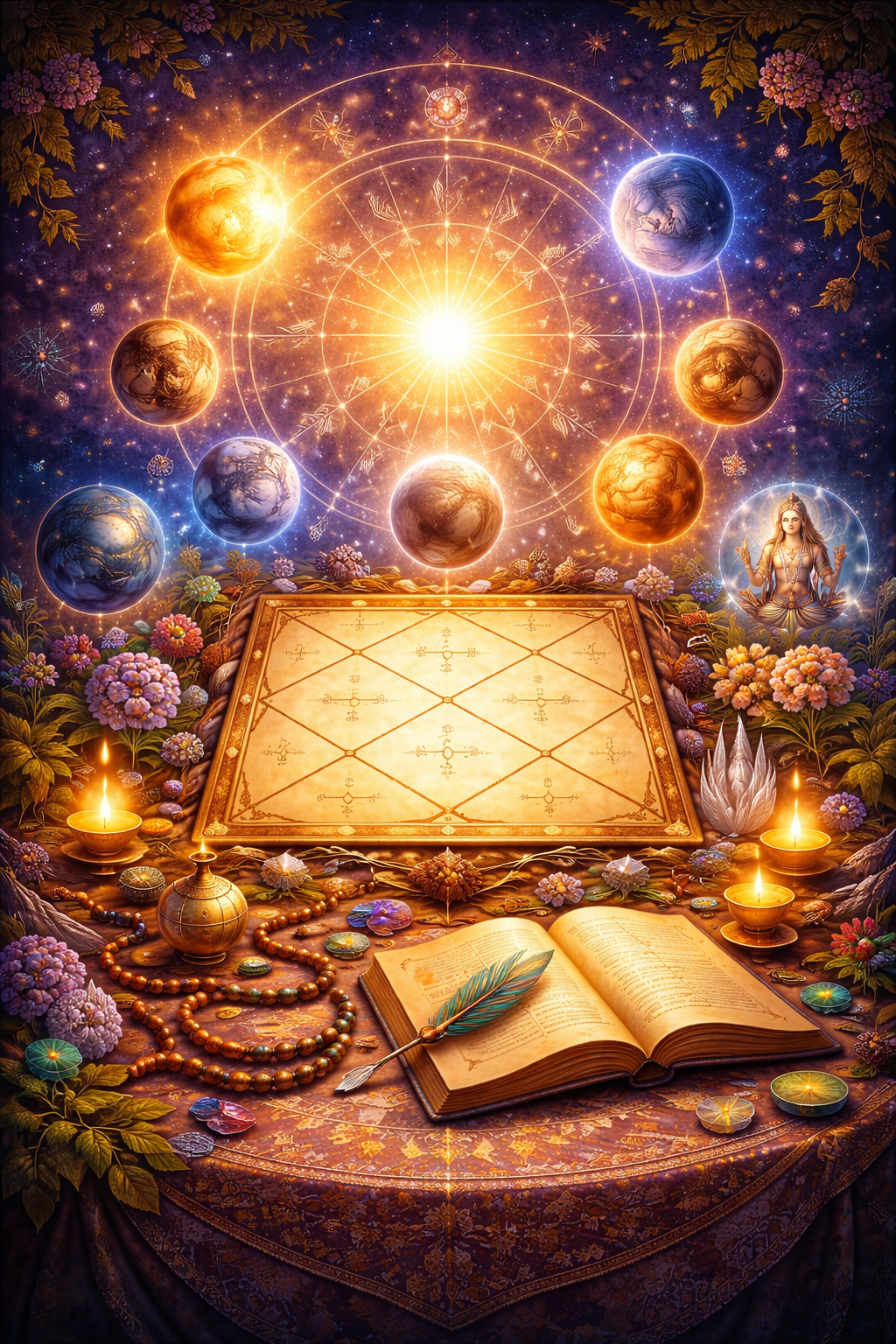
Human beings have always looked upward. Long before satellites and telescopes, before physics equations and space probes, our ancestors watched the sky with quiet curiosity. They noticed patterns: the steady march of seasons, the dance of planets, the rhythm of eclipses, the predictable return of stars. Somewhere in that long observation emerged a profound question: could these celestial rhythms also reflect rhythms within human life? From that curiosity grew what we now call Vedic astrology, or Jyotisha, one of the ancient sciences preserved within the broader body of Vedic knowledge. The word itself means “the science of light.” Not merely the light of planets and stars, but the symbolic light that illuminates the relationship between the cosmos and the human experience. Yet it is important to approach astrology with balance. At its best, astrology is not a prison of fate. It is closer to a cosmic weather report or a marine compass. A sailor studies wind and currents before navigating the sea, but the sailor still holds the wheel. Similarly, astrology may show tides and currents of life, but the steering remains with the individual. Understanding this distinction removes fear and replaces it with curiosity. The Nine Planetary Forces – The Navagrahas At the core of Vedic astrology are the nine planetary influences, collectively known as the Navagrahas. These planets are not seen merely as physical bodies in space, but as symbolic forces representing various dimensions of human life. The Sun (Surya) represents vitality, authority, confidence, and the soul’s radiance. It symbolizes leadership and the inner spark that drives purpose. The Moon (Chandra) governs the mind, emotions, intuition, and the subtle tides of human feeling. Just as the moon influences ocean tides, it is believed to influence emotional rhythms. Mars (Mangala) represents courage, strength, action, and the warrior spirit. It provides initiative and the capacity to confront challenges. Mercury (Budha) governs communication, intelligence, adaptability, and learning. It is associated with speech, logic, and curiosity. Jupiter (Guru or Brihaspati) represents wisdom, generosity, philosophy, and expansion. It symbolizes knowledge, guidance, and higher learning. Venus (Shukra) governs beauty, relationships, art, pleasure, and harmony. It is often associated with refinement and aesthetic appreciation. Saturn (Shani) represents discipline, endurance, patience, and time. Saturn is often misunderstood as harsh, but in many ways it is the great teacher of maturity and structure. Rahu, the north node of the Moon, symbolizes ambition, innovation, curiosity, and worldly desires. It pushes the individual toward growth in unfamiliar territory. Ketu, the south node, represents detachment, introspection, and spiritual insight. While Rahu pushes outward, Ketu invites inward reflection. In truth, none of these planetary influences are inherently “good” or “bad.” They are simply forces that shape experiences in different ways—some gentle, some demanding, but all potentially transformative. The Twelve Houses – Domains of Life In a natal chart, the sky is divided into twelve houses, each representing a field of life experience. The first house represents identity, personality, and physical presence. The second house relates to resources, speech, and values. The third house governs courage, effort, and communication. The fourth house symbolizes home, emotional foundations, and inner peace. The fifth house relates to creativity, children, and intelligence. The sixth house concerns service, health, and obstacles. The seventh house governs partnerships and relationships. The eighth house deals with transformation, mystery, and deep change. The ninth house represents philosophy, higher knowledge, and fortune. The tenth house governs career, reputation, and worldly achievements. The eleventh house represents gains, networks, and aspirations. The twelfth house relates to spiritual reflection, distant journeys, and release. Together these houses create a symbolic map of human life. The Twelve Rashis – Zodiac Signs Complementing the houses are the twelve zodiac signs, known as Rashis. Each sign expresses energy differently. Aries embodies initiative and courage. Taurus values stability and comfort. Gemini thrives on curiosity and conversation. Cancer nurtures and protects. Leo radiates confidence and creativity. Virgo refines and analyzes. Libra seeks harmony and balance. Scorpio explores depth and transformation. Sagittarius searches for wisdom and adventure. Capricorn builds patiently with discipline. Aquarius imagines innovation and societal progress. Pisces flows with compassion and spirituality. These signs color how planetary influences manifest in the chart. Ascendant, Lagna Lord, and Rashi Lord One of the most important elements of a birth chart is the Ascendant, or Lagna. It is the zodiac sign rising on the eastern horizon at the exact moment of birth. The Ascendant sets the framework for the entire chart and represents the individual's outward personality and life direction. The Lagna Lord is the ruling planet of the Ascendant sign and is often considered a guiding force in the chart. The Rashi Lord, connected to the Moon sign, reflects emotional temperament and inner response patterns. Together they reveal how a person interacts with the world both externally and internally. Planetary Yogas – Cosmic Combinations In astrology, certain combinations of planets create what are called Yogas. These yogas indicate potential strengths such as leadership, prosperity, creativity, or spiritual growth. However, yogas should be seen as possibilities rather than guarantees. Just as fertile soil still requires cultivation, positive planetary combinations require effort, discipline, and ethical living to manifest fully. Dashas and Transits – Timing in Astrology A unique feature of Vedic astrology is the Dasha system, particularly the Vimshottari Dasha, which describes planetary periods throughout a lifetime. Each phase highlights themes associated with a particular planet. Alongside Dashas are transits, the ongoing movement of planets in the sky relative to the natal chart. Transits resemble changing seasons—some favorable for growth, others encouraging patience and introspection. These cycles remind us that life unfolds in phases. Astrology and Life Themes Astrology is often used to explore patterns related to health, finances, career, and relationships. Certain planetary influences may highlight areas requiring attention or effort. But it is essential to remember: a chart describes tendencies, not fixed outcomes. Human intention, discipline, and character remain powerful forces capable of transforming circumstances. The Self Beyond the Chart Perhaps the most important truth within Vedic wisdom is this: the self is stronger than the chart. Determination, integrity, compassion, and effort can reshape many difficult planetary patterns. Astrology can show terrain, but it does not remove free will. A person who cultivates inner strength often transcends the limitations suggested by a chart. Thoughts, Words, and the Universe Many spiritual traditions emphasize that thoughts, words, and actions influence reality. Repeated patterns of thinking gradually shape behavior and choices. When the mind is filled with clarity, gratitude, and purpose, life tends to reflect those qualities more often. In this sense, astrology can serve as a mirror reminding us to maintain healthy internal alignment. Remedies – Traditional and Modern Traditional Vedic astrology offers many remedies: chanting mantras, performing acts of charity, practicing discipline, and cultivating gratitude. Modern interpretations often expand remedies to include meditation, lifestyle changes, mindfulness practices, and psychological awareness. At their core, these remedies aim to harmonize the individual with life’s rhythms. A Glimpse of the Ishavasya Upanishad One of the most beautiful philosophical foundations behind Vedic wisdom appears in the Ishavasya Upanishad, which begins with the profound statement that the entire universe is pervaded by the divine. It teaches that life should be lived with awareness, moderation, and responsibility—recognizing that everything is interconnected. Three Universal Mantras Among countless sacred chants, three are widely practiced: Maha Mrityunjaya Mantra Om Tryambakam Yajamahe Sugandhim Pushtivardhanam Urvarukamiva Bandhanan Mrityor Mukshiya Maamritat Meaning: A prayer for healing, protection, and liberation from fear. Gayatri Mantra Om Bhur Bhuvah Swaha Tat Savitur Varenyam Bhargo Devasya Dheemahi Dhiyo Yo Nah Prachodayat Meaning: A prayer seeking illumination of the mind and clarity of thought. Hare Krishna Maha Mantra Hare Krishna Hare Krishna Krishna Krishna Hare Hare Hare Rama Hare Rama Rama Rama Hare Hare Meaning: A devotional chant celebrating divine love and spiritual joy. There are thousands of other Vedic hymns and devotional compositions that guide individuals through different phases of life. Astrology as an Ocean Vedic astrology is often compared to a vast ocean. Some choose to dive deeply into its study. Others simply enjoy understanding its basic ideas. Some remain respectfully skeptical. All of these approaches are valid. What matters most is that astrology should never become a source of fear. Choosing an Astrologer If one chooses to seek astrological guidance, selecting a responsible astrologer is essential. A good astrologer emphasizes growth, awareness, and practical wisdom rather than alarming predictions. In modern times, AI tools can also analyze charts and highlight patterns with impressive detail. Yet human astrologers still bring intuition, experience, and contextual understanding that machines cannot fully replicate. Final Reflection Ultimately, Vedic astrology invites us to look at the sky while remaining grounded on earth. The stars may offer signals. The planets may show patterns. But the most powerful force shaping a life remains the human spirit itself. The sky may guide. But the steering wheel is still in our hands.
Astrology shows the tides. The sailor still steers.